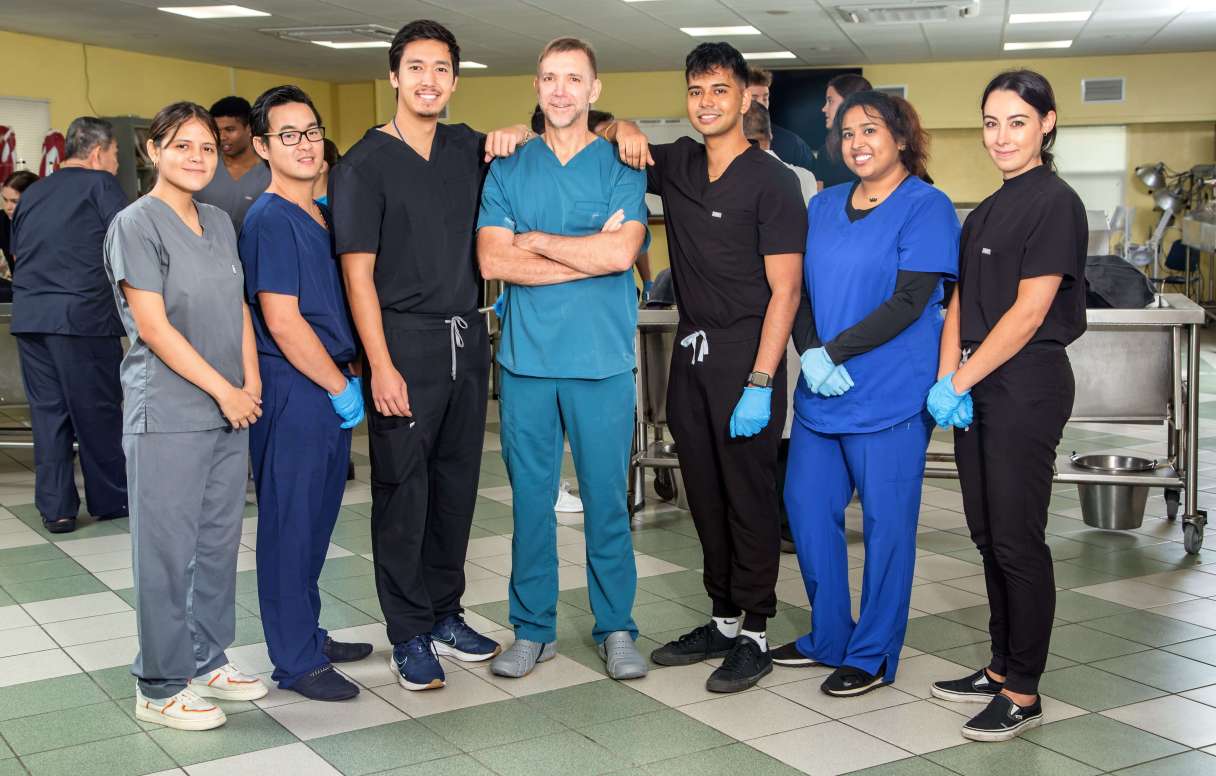
Student Consumer Information
This Student Consumer Information document provides prospective and current students with clear and transparent information about our medical programs, costs, policies and student outcomes. It is intended to help students make informed decisions about their education and future career.
Annual Notice of Availability of Consumer Information
In accordance with the Higher Education Act of 1965, as amended (HEA), and 34 CFR 668.41 through 668.43, Saba University School of Medicine (SUSOM) provides this document as its annual notice of the consumer information available to enrolled and prospective students. This document, together with the disclosures below, describes the institution, its academic programs, its cost of attendance, its refund and withdrawal policies, the federal student aid programs in which the institution participates, and the rights and responsibilities of students receiving Title IV assistance. Paper copies of any disclosure referenced in this document are available upon request from the Office of Financial Aid.
In accordance with 34 CFR 668.43(a)(8) and 668.44, SUSOM has designated the following individuals as available full-time to assist enrolled and prospective students in obtaining the institutional and financial assistance information described in this document: the Director of Financial Aid and the Office of Financial Aid staff, reachable at (978) 862-9600, option 4, or at finaid@saba.edu. Upon request, this information will be provided to a prospective student before the student enrolls or enters into any financial obligation with the institution.
Office of Financial Aid Contact Information
Financial Aid Department: +1 (978) 862-9600, option 4 | finaid@saba.edu
About the Institution
Accreditation and Approvals
Saba University School of Medicine is accredited by the NVAO, whose standards the U.S. Department of Education has found comparable to U.S. medical school accreditation, and holds approvals in New York, California, Florida, and Kansas. Documents describing our accreditation and approvals are available on request.
Information about the bodies that accredit, approve, and license the institution, with documents available for review on request.
https://www.saba.edu/why-saba/accreditation-and-approval
Documents describing the institution’s accreditation, approval, or licensing may be reviewed by any enrolled or prospective student upon request to the Office of Admissions.
Professional Licensure and USMLE
Our MD program prepares graduates for medical licensure. Students are eligible to take the USMLE, and graduates who pass the required examinations can pursue licensure in all 50 U.S. states, Canada, the United Kingdom, and other countries. Requirements vary by state, so verify the rules in the state where you plan to practice.
How the MD program prepares graduates for licensure, USMLE eligibility, and the institution’s accreditation and state approvals.
The SUSOM MD program prepares graduates for medical licensure. SUSOM is accredited by the Accreditation Organization of the Netherlands and Flanders (NVAO), which is recognized by the World Federation of Medical Education (WFME). The United States Department of Education, through the National Committee on Foreign Medical Education and Accreditation (NCFMEA), has determined that the NVAO’s accreditation standards for SUSOM are comparable to those used by the Liaison Committee on Medical Education (LCME), the accrediting body for MD-granting medical programs in the United States.
SUSOM meets the Educational Commission for Foreign Medical Graduates (ECFMG) eligibility requirements, which allow students to take the United States Medical Licensing Examination (USMLE). SUSOM MD program students who fulfill their academic requirements are eligible to sit for USMLE Step 1 (after Basic Science) and Step 2 CK (after Clinical Medicine rotations). Graduates who successfully complete the requisite licensing examinations and all applicable requirements are eligible to practice medicine in all 50 states of the United States, Canada, the United Kingdom, and other countries. Licensure requirements vary by jurisdiction and are subject to change; students are strongly encouraged to verify the current requirements of the state or jurisdiction in which they intend to practice.
The following bodies have approved, recognized, or licensed SUSOM: Approved by the New York State Education Department, which provides access to clerkships and residencies within that state. Recognized by the Medical Board of California; recognition is necessary for licensure, and other states follow California’s recognition for licensure. Licensed by the Florida Department of Education’s Commission for Independent Education; additional information regarding this institution may be obtained by contacting the Florida Department of Education, Commission for Independent Education, 325 West Gaines Street, Tallahassee, FL 32399-0400, (888) 224-6684 (toll-free), www.fldoe.org/cie. Approved by the Kansas State Board of Healing Arts. Additional information is available at https://www.saba.edu/why-saba/accreditation-and-approval.
Academic Programs, Facilities and Faculty
Learn about our degree program, campus facilities, faculty and academic calendar.
Where to find information about the degree program, campus facilities, faculty, and academic calendar.
In accordance with 34 CFR 668.43(a)(5), information about the institution’s academic programs, including current degree programs and other educational and training programs; the instructional, laboratory, and other physical facilities related to these programs; and the institution’s faculty and other instructional personnel is available at the following locations:
- Academic programs: https://www.saba.edu/academics and https://www.saba.edu/academics/programs/med-program
- Facilities: https://www.saba.edu/academics/facilities
- Faculty and administration: https://www.saba.edu/academics/saba-faculty-and-administration
- Academic calendar and catalog: https://www.saba.edu/academics/academic-calendar-and-catalog
Any plans by the institution to improve its academic programs are described in the academic catalog and institutional publications.
Services for Students with Disabilities
We describe the services and accommodations available to students with disabilities and how to request them.
The services and accommodations available to students with disabilities and how to request them.
In accordance with 34 CFR 668.43(a)(7), SUSOM describes the services and facilities available to students with disabilities, including those with intellectual disabilities. Students seeking reasonable accommodations should contact the Office of Student Support Services at (978) 862-9600 or via https://www.saba.edu/academics/student-support. Information on student support services, including academic support and counseling resources, is available at https://www.saba.edu/academics/student-support. Accommodation requests are reviewed on an individualized basis, and supporting documentation may be required. Information on the institution’s technical standards for admission and continued enrollment is available at https://www.saba.edu/admissions/technical-standards.
Written Arrangements for Clinical Training
Clinical rotations are completed at affiliated teaching hospitals; a list of clinical affiliates is available on request.
Clinical rotations are completed at affiliated teaching hospitals; a list of clinical affiliates is available on request.
In accordance with 34 CFR 668.43(a)(12), SUSOM discloses that portions of the Clinical Medicine curriculum are delivered through written arrangements with affiliated teaching hospitals and clinical training sites in the United States and Canada. Clinical clerkships are completed at these affiliated sites under the oversight of the Office of the Associate Dean, Clinical Medicine. A list of current clinical affiliates, including the portion of the educational program provided at each site and the method of delivery, is available upon request from the Office of the Associate Dean, Clinical Medicine, and at https://www.saba.edu/academics/programs/med-program/clinical-medicine. Estimated additional costs associated with clinical training, including elective clerkship surcharges, are described in Section B.
Study Abroad
Enrollment in an approved study abroad program may count as enrollment for federal aid purposes; the MD program itself is delivered at our campus and affiliated clinical sites.
How enrollment in an approved study abroad program is treated for federal student aid purposes.
In accordance with 34 CFR 668.43(a)(9), a student’s enrollment in a study abroad program approved for credit by the home institution may be treated as enrollment at the home institution for purposes of applying for assistance under the Title IV, HEA programs. SUSOM does not currently operate a separate study abroad program; the MD program is delivered on the institution’s campus and at affiliated clinical training sites, as described in the Written Arrangements for Clinical Training section.
Costs, Refunds and Withdrawal
Cost of Attendance
The estimated cost of attending for the 2026-2027 year, semester by semester, for new students and for continuing students eligible for the federal interim exception. The COA sets the maximum financial aid you can receive.
The estimated cost of attendance for 2026-2027, semester by semester, for new students and for continuing students eligible for the federal interim exception. The COA sets the maximum financial aid a student may receive.
The Cost of Attendance (COA) is an estimate of a student’s educational expenses for the period of enrollment and is developed in accordance with Section 472 of the HEA. Components include tuition and fees; books, course materials, supplies, and equipment; housing and food; transportation; miscellaneous personal expenses; and federal loan fees. The COA establishes the maximum amount of financial aid, from all sources combined, that a student may receive for the award year. The following tables present the estimated COA for the 2026-2027 award year. Consistent with the institution’s two-cohort tuition structure, the first table applies to students matriculating in the September 2026 term and thereafter, and the second table applies to students matriculating before the September 2026 term. Current tuition and fee schedules are available at https://www.saba.edu/admissions/tuition-and-fees.
| Cost of Attendance 2026-27: New Students (matriculating in the September 2026 term and thereafter) | |||||||||||
| Semester | Basic Science | Clinical Medicine | |||||||||
| 1 | 2 | 3 | 4 | 5 | 6 | 7 | 8 | 9 | 10 | TOTAL | |
| Tuition | $20,480 | $20,480 | $20,480 | $20,480 | $20,480 | $24,950 | $24,950 | $24,950 | $24,950 | $24,950 | $227,150 |
| Admin Fees | $8,270 | $8,270 | $8,270 | $8,270 | $8,270 | $6,050 | $6,050 | $6,050 | $6,050 | $6,050 | $71,600 |
| Visa Fee | $210 | $210 | |||||||||
| Books & Supplies | $1,968 | $2,270 | $1,568 | $1,544 | $678 | $1,200 | $1,200 | $1,200 | $1,200 | $1,200 | $14,028 |
| Housing & Food | $10,600 | $10,950 | $10,950 | $10,950 | $10,950 | $14,550 | $14,550 | $14,550 | $14,550 | $14,550 | $127,150 |
| Utilities | $950 | $950 | $950 | $950 | $950 | $1,000 | $1,000 | $1,000 | $1,000 | $1,000 | $9,750 |
| Phone and Internet | $880 | $880 | $880 | $880 | $880 | $880 | $880 | $880 | $880 | $880 | $8,800 |
| Malpractice Insurance | $295 | $295 | $295 | $295 | $295 | $1,475 | |||||
| USMLE Exams | $1,000 | $1,000 | $2,000 | ||||||||
| Transportation | $1,200 | $1,200 | $1,200 | $1,200 | $1,200 | $1,600 | $1,600 | $1,600 | $1,600 | $1,600 | $14,000 |
| Personal Expenses | $1,000 | $1,000 | $1,000 | $1,000 | $1,000 | $1,000 | $1,000 | $1,000 | $1,000 | $1,000 | $10,000 |
| Graduation Fee | $500 | $500 | |||||||||
| Loan Fees* | $265 | $265 | $265 | $265 | $265 | $265 | $265 | $265 | $265 | $265 | $2,650 |
| Total | $45,823 | $46,265 | $45,563 | $45,539 | $45,673 | $51,790 | $51,790 | $52,790 | $51,790 | $52,290 | $489,313 |
| Cost of Attendance 2026-27: Legacy/Continuing Students Eligible for the Federal Interim Exception | |||||||||||
| Semester | Basic Science | Clinical Medicine | |||||||||
| 1 | 2 | 3 | 4 | 5 | 6 | 7 | 8 | 9 | 10 | TOTAL | |
| Tuition | $20,480 | $20,480 | $20,480 | $20,480 | $20,480 | $24,950 | $24,950 | $24,950 | $24,950 | $24,950 | $227,150 |
| Admin Fees | $8,270 | $8,270 | $8,270 | $8,270 | $8,270 | $6,050 | $6,050 | $6,050 | $6,050 | $6,050 | $71,600 |
| Visa Fee | $210 | $210 | |||||||||
| Books & Supplies | $1,968 | $2,270 | $1,568 | $1,544 | $678 | $1,200 | $1,200 | $1,200 | $1,200 | $1,200 | $14,028 |
| Housing & Food | $10,600 | $10,950 | $10,950 | $10,950 | $10,950 | $14,550 | $14,550 | $14,550 | $14,550 | $14,550 | $127,150 |
| Utilities | $950 | $950 | $950 | $950 | $950 | $1,000 | $1,000 | $1,000 | $1,000 | $1,000 | $9,750 |
| Phone and Internet | $880 | $880 | $880 | $880 | $880 | $880 | $880 | $880 | $880 | $880 | $8,800 |
| Malpractice Insurance | $295 | $295 | $295 | $295 | $295 | $1,475 | |||||
| USMLE Exams | $1,000 | $1,000 | $2,000 | ||||||||
| Transportation | $1,200 | $1,200 | $1,200 | $1,200 | $1,200 | $1,600 | $1,600 | $1,600 | $1,600 | $1,600 | $14,000 |
| Personal Expenses | $1,000 | $1,000 | $1,000 | $1,000 | $1,000 | $1,000 | $1,000 | $1,000 | $1,000 | $1,000 | $10,000 |
| Graduation Fee | $500 | $500 | |||||||||
| Loan Fees* | $1,601 | $1,620 | $1,590 | $1,589 | $1,595 | $1,853 | $1,853 | $1,896 | $1,853 | $1,875 | $17,325 |
| Total | $47,159 | $47,620 | $46,888 | $46,863 | $47,003 | $53,378 | $53,378 | $54,421 | $53,378 | $53,900 | $503,988 |
*Estimated federal loan fees are based on Federal Direct Unsubsidized Loan borrowing at a 1.057 percent origination fee. Borrowers eligible for the federal interim exception who borrow Graduate PLUS Loan funds incur a 4.228 percent origination fee on those funds. Actual amounts vary by borrower. Bracketed amounts are carried forward from the 2025-2026 budget and must be confirmed or updated using approved 2026-2027 figures before publication.
- Students may incur additional surcharges for elective clinical clerkships within the Clinical Medicine portion of the program. Some hospitals may require a surcharge for elective clerkships. While many elective clinical clerkship sites do not require a surcharge, those that do currently charge between $50 and $550 per week.
- Before students choose clinical sites for their rotations, they will receive a list detailing surcharges at each hospital to ensure they can make informed decisions. This list is also available to all students upon request from the Office of the Associate Dean, Clinical Medicine.
- While Cost of Attendance budgets include an estimate for surcharges, the actual charges may exceed these estimates, depending on the elective rotations selected by students, and thus may not be included in the financial aid budget.
Refund Policy
How tuition is refunded if you withdraw, including the full refund before the first day of the semester, the three-day seat deposit window for new applicants and the refund schedule after classes begin.
How tuition is refunded on withdrawal, including the full refund before the first day of the semester, the three-day seat deposit window for new applicants, and the refund schedule after classes begin.
Tuition Refund Policy: Tuition and fees shall be refunded in full, less an administrative fee of $100 and the $750 acceptance deposit, if notice of withdrawal is received prior to the first day of enrollment. Tuition and fees shall also be refunded in full for the current enrollment period, less an administrative fee of $100 and the acceptance deposit, under the following circumstances:
- Courses cancelled by the institution
- Involuntary call to active military duty
- Documented death of the student
- Exceptional circumstances, with approval of the President or designee of the institution
Application fees are nonrefundable. Refunds will be calculated by the Student Accounts Office and will be refunded within (30) days of withdrawal.
The tuition will be refunded as follows:
- A refund of 100% of the tuition for which the student is obligated shall be issued if the student withdraws prior to the first day of enrollment.
- A refund of 90% of the tuition for which the student is obligated shall be issued if the student’s last date of attendance is prior to the expiration of 10% of the period of enrollment for which the student was charged or obligated.
- A refund of 50% of the tuition for which the student is obligated shall be issued if the student’s last date of attendance is prior to the expiration of 25% of the period of enrollment for which the student was charged or obligated but more than 10%.
- A refund of 25% of the tuition for which the student is obligated shall be issued if the student’s last date of attendance is prior to the expiration of 50% of the period of enrollment for which the student was charged or obligated but more than 25%.
- In case of withdrawal after 50% of the period of enrollment, the student is obligated for full tuition and fees.
All monies paid by an applicant will be refunded if cancellation occurs within three business days after signing the terms of enrollment and making initial payment. In order to be eligible for a tuition refund, students must obtain a financial clearance letter from the Administrative Office at Saba University and a formal withdrawal form must be completed and authorized by the Dean.
Return of Title IV Funds (R2T4)
If you withdraw during a semester, federal law determines how much of your federal aid you have earned and how much must be returned. This explains the calculation and what it means for your account.
When a student withdraws during a semester, federal law determines how much federal aid has been earned and how much must be returned.
Federal law and 34 CFR 668.22 specify how Saba University School of Medicine (“SUSOM”) must determine the amount of Title IV program assistance a student earns if the student withdraws from school. See the Leaves of Absence (LOA) and Withdrawal’s information following this section, as well as the withdrawal process. The Office of Financial Aid calculates R2T4, and the Business Office transfers the funds. The Office of Financial Aid uses worksheets and software provided by the U.S. Department of Education to calculate R2T4 amounts. All unearned funds must be returned within 45 days of the institution’s determination that the student withdrew. If you have questions about your Title IV program funds, you can call the Federal Student Aid Information Center at 1-800-4-FED-AID (1-800-433-3243). TTY users may call 1-800-730-8913. Information is also available at https://studentaid.gov.
When a student withdraws during a payment period, the amount of Title IV program assistance earned up to that point is determined by a specific formula. The date of withdrawal is the earlier of the date the student notified the Registrar or Program Director of the intent to withdraw and the date the student submitted the withdrawal form. If the student (or the school on the student’s behalf) received less assistance than the amount earned, the student may receive the additional funds. If the student received more assistance than was earned, the excess funds must be returned by the school and/or the student.
The Saba attendance policy is outlined in the university catalog and the student handbooks. All Basic Science courses require at least 80% attendance (some courses may require more), and full attendance is required during clinical clerkships. Students who do not meet attendance requirements are reported to the university’s Registrar, who notifies the student’s Program Director of the nonattendance. The Program Director will consult with the student’s faculty to verify the last date of attendance. Without an official Withdrawal Form, the university will use the last date of attendance to compute the R2T4 formula.
When a student notifies the Program Director or a faculty member of the intent to withdraw, the student must be informed of the requirement to complete the Official Withdrawal Form. The Program Director or faculty member must document the date the student provided notification and share that information with the university Registrar. If the student fails to file the Withdrawal Form, or if there is a delay between the notification and the form’s filing, the earlier notification date will be used to calculate the R2T4 formula. If a student receives all failing grades for a semester, the Program Director will contact the faculty members to determine whether the failing grades were earned or reflect a lack of attendance. If it is determined that those grades were the result of poor attendance, the Program Director and faculty will attempt to identify the last day of attendance and use that date in the R2T4 calculation. If the exact date cannot be determined, the university will assume 50% attendance and use the midpoint of the payment period as the last day of attendance. Students who do not attend even one class are ineligible for Title IV funds, and all loan proceeds will be returned.
The amount of assistance earned is determined on a pro rata basis. The payment period is the semester for which the loan was certified, and the percentage earned is calculated by dividing the number of calendar days attended by the total number of calendar days in that period. For example, if the student completes 30% of the payment period, the student has earned 30% of the assistance originally scheduled. Once the student has completed more than 60% of the payment period, all assistance scheduled for that period is considered earned. If the student did not receive all the funds earned, the student may be due a post-withdrawal disbursement. If the post-withdrawal disbursement includes loan funds, the student may decline those funds to avoid additional debt. The Office of Financial Aid will use the R2T4 worksheets provided by the U.S. Department of Education to determine how much of the loan may be retained and how much must be returned.
Saba may automatically apply all or part of a post-withdrawal disbursement (including loan funds, if the student accepts them) to tuition, fees, and institutionally contracted housing and food charges. For all other school charges, the school must obtain the student’s permission to apply the post-withdrawal disbursement. If the student does not give permission, the student will not be offered the funds. However, it may be in the student’s best interest to allow the school to retain the funds to reduce the debt owed to the school.
Some Title IV funds a student may have been scheduled to receive cannot be disbursed after the student withdraws due to other eligibility requirements. If the student receives, or the school receives on the student’s behalf, excess Title IV program funds that must be returned, the school must return a portion of the excess equal to the lesser of:
- The institutional charges multiplied by the unearned percentage of the funds, or
- The full amount of excess funds.
The school must return this amount even if it did not keep this amount of the Title IV program funds. If the school is not required to return all of the excess funds, the student must return the remaining amount. Any loan funds that must be repaid by the student are repaid in accordance with the terms of the promissory note; that is, scheduled payments are made to the loan holder over time. Students who have received a refund of their loan proceeds before withdrawing may be required to return part or all of those funds.
Title IV funds will be returned in the following order:
- Federal Direct Unsubsidized Loans
- Federal Direct PLUS Loans (Graduate PLUS, for borrowers eligible under the federal interim exception)
The requirements for Title IV program funds when students withdraw are separate from any refund policy the school may have. Therefore, the student may still owe the school for unpaid institutional charges. The school may also charge the student for any Title IV program funds the school was required to return. Students may obtain a copy of the refund policy from the Business Office.
Leaves of Absence and Withdrawals
Saba grants academic leaves of absence, which are treated as withdrawals for federal aid purposes. Before requesting a leave, meet with Financial Aid to review the effect on your loans, grace period, and future eligibility.
Saba grants academic leaves of absence, which are treated as withdrawals for federal aid purposes. Meet with the Office of Financial Aid before requesting a leave.
Important notice for Title IV loan recipients: Saba grants academic leaves of absence. An academic leave of absence does not satisfy the conditions for an approved leave of absence for Title IV purposes under 34 CFR 668.22(d). Accordingly, any leave of absence granted by SUSOM is treated as a withdrawal for Title IV purposes as of the date the leave begins, is reported to the National Student Loan Data System (NSLDS) as a withdrawal, and requires a Return of Title IV Funds calculation. A leave of absence also ends a borrower’s eligibility for the federal interim exception described in Section G. Students considering a leave of absence should meet with the Office of Financial Aid before submitting a request to fully understand the consequences for loan repayment, grace period exhaustion, and future borrowing eligibility.
Definitions:
Approved Leaves of Absence (LOA)
An LOA is a temporary interruption in a student’s program of study. LOA refers to the specific time period during a program when a student is not in attendance and will return to complete the program. Students returning from a LOA are not required to re-apply for admission but must re- register for their courses.
Unapproved Leaves of Absence
A school may grant a student an LOA that does not meet the conditions to be an approved LOA for Title IV purposes (for example, for academic reasons). However, any LOA that does not meet all of the conditions for an approved LOA is considered a withdrawal for Title IV purposes.
Official Withdrawal
A “withdrawal” refers to a student’s intent to completely terminate studies at an institution with no expectation of return. Students who subsequently decide to return to their studies must re-apply for admission through the university’s Office of Admissions.
Unofficial Withdrawal
An unofficial withdrawal is one where the school has not received notice from the student that the student has ceased or will cease attending the school
Note: Students who withdraw from courses or the program receive a grade of “W” on their transcript. The grade is considered the same as n “F” grade in calculating the quantitative aspect of the Satisfactory Academic Progress standards and may affect the student’s future eligibility for Financial Aid.
LOA and Withdrawal Request Forms
The form required by SUSOM to request a LOA or a Withdrawal is available on the campus website and from the Registrar.
Conditions for an Approved LOA Under Title IV
For general reference, federal regulations provide that an LOA qualifies as an approved LOA for Title IV purposes only if the following conditions are met:
- All LOA requests must be submitted in writing to the Program Director and include the reason for the student’s request. The form must be signed and dated by the student and specify the dates the LOA should begin and end.
- Students must apply in advance for an LOA unless unforeseen circumstances prevent them from doing so.
- The reason for the LOA must be generally non-academic in nature and must support a reasonable expectation that the student will return from the LOA within the allowed time frame.
- The LOA, together with any additional leaves of absence, must not exceed 180 days in any 12-month period, including days when school is not in session.
All LOA requests will be reviewed by the Program Director, the university Registrar, and the Director of Financial Aid. The student will be notified in writing by the Program Director of the university’s decision. Because Saba grants only academic leaves of absence, every approved leave request is processed as a withdrawal for Title IV purposes.
During any leave, the institution will not assess the student any additional institutional charges, the student’s financial need will not increase, and the student will not be eligible for any additional federal student aid disbursements.
Consequences of Withdrawal for Loan Recipients
Because a leave of absence at Saba is reported as a withdrawal, the institution must report the student’s change in enrollment status to NSLDS as of the withdrawal date. The student’s grace period begins on the withdrawal date, and a student who is away from the program longer than the grace period will enter repayment. Before granting a leave of absence, Saba will inform a student who is a Title IV loan recipient of the possible consequences of a withdrawal on the student’s loan repayment terms, including the exhaustion of the student’s grace period.
Approved LOA’s
An LOA must meet certain conditions to be counted as a temporary interruption in a student’s education instead of being counted as a withdrawal requiring a school to perform a Return calculation. If an LOA does not meet the conditions, the student is considered to have ceased attendance and to have withdrawn from the school, and the school is required to perform a Return calculation.
In order for an LOA to qualify as an approved LOA:
- All requests for LOA’s be submitted in writing to the Program Director and include the reason for the student’s request. The form must be signed and dated by the student and specify the date the student wants the LOA to begin and end.
- Students must apply in advance for an LOA unless unforeseen circumstances prevent the student from doing so.
- The situation described for the reason for the LOA must be generally non-academic in nature and must be one that leads to a reasonable expectation that the student will return from the LOA within the allowed time frame.
- The LOA together with any additional leaves of absence must not exceed a total of 180 days in any 12-month period including days in which school is not is session.
All requests for LOA’s will be reviewed by the Program Director, the university Registrar and the Director of Financial Aid. The student will be notified in writing by the Program Director of the university’s decision.
During the LOA, the institution will not assess the student any additional institutional charges, the student’s financial need will not increase, and therefore, the student will not be eligible for any additional disbursements of Federal Student Aid.
If the student is a Direct Loan recipient, the school will explain to the student, prior to granting the LOA, the effects that the student’s failure to return from an LOA may have on the student’s loan repayment terms, including the expiration of the student’s grace period.
A student granted an LOA that meets the criteria stated above is not considered to have withdrawn, and no Return calculation is required. Upon the student’s return from the leave, he or she continues to earn the Federal Student Aid previously awarded for the period.
Completion of Coursework Upon Return
In as much as approved leaves of absence are viewed as temporary interruptions in a student’s attendance, and since the academic programs at SUSOM are considered term-based programs, where the payment period is the term, a student returning from an LOA must do so at a time when he or she can complete the term in order to complete the payment period and be eligible to receive a second or subsequent disbursement. Therefore, for students enrolled in credit-hour term programs, in order for an LOA to be an LOA, the school must allow a student returning from an LOA to complete the coursework that he or she began prior to the LOA.
Students Who Return Earlier Than Anticipated
The school may permit a student to return to class before the expiration of the student’s LOA in order to review material previously covered. However, until the student has resumed the academic program at the point where he or she began the LOA, the student is considered to still be on the approved LOA. The days the student spends in class before the course reaches the point at which the student began his or her LOA must be counted in the 180 days maximum for an approved leave of absence. A student repeating coursework while on LOA must reach the point at which he or she interrupted training within the 180 days of the start of the student’s LOA.
Student Who Fail to Return From LOA’s
If a student does not return to the school at the expiration of an approved LOA (or a student takes an unapproved LOA), the student’s withdrawal date is the date the student began the LOA.
Explanation of consequences of withdrawal to loan recipients A student who is granted an approved LOA is considered to remain in an in-school status for Title IV loan repayment purposes. If a student on an approved LOA fails to return, the school must report to the loan holder the student’s change in enrollment status as of the withdrawal date. One possible consequence of not returning from an LOA is that a student’s grace period for a Title IV program loan might be exhausted. Therefore, in order for a LOA to be an approved LOA, prior to granting a leave of absence, a school must inform a student who is a Title IV loan recipient of the possible consequences a withdrawal may have on the student’s loan repayment terms, including the exhaustion of the student’s grace period.
Unapproved LOA’s
A school may grant a student an LOA that does not meet the conditions to be an approved LOA for Title IV purposes (for example, for academic reasons). However, any LOA that does not meet all of the conditions for an approved LOA is considered a withdrawal for Title IV purposes. The student’s withdrawal date is the date the student begins the LOA. An unapproved LOA may be treated as an official withdrawal since the school would have previously granted an LOA. Therefore, the school would know immediately that the student had ceased attendance for Title IV purposes, and must use the specified withdrawal date in the Return calculation.
Financial Aid
Federal Student Aid at Saba
Eligible U.S. students may borrow Federal Direct Unsubsidized Loans; Grad PLUS Loans is available only to borrowers who qualify for the federal interim exception. Canadian students use Canadian federal and provincial aid.
As a foreign institution, SUSOM participates in the William D. Ford Federal Direct Loan Program, administered by the U.S. Department of Education. Eligible U.S. students in the MD program may borrow Federal Direct Unsubsidized Loans. Graduate PLUS Loans are available only to borrowers who qualify for the federal interim exception described below. Students attending a foreign institution are not eligible for Federal Pell Grants, Federal Supplemental Educational Opportunity Grants, Direct Subsidized Loans, or Federal Work-Study. Canadian students are not eligible for U.S. Title IV assistance and are directed to Canadian federal and provincial student aid processes through the Financial Aid Canada office; see https://www.saba.edu/admissions/financial-aid/canada. Information about institutional scholarships is available at https://www.saba.edu/admissions/scholarships. Complete information about U.S. federal financial aid at SUSOM is available at https://www.saba.edu/admissions/financial-aid/united-states. Whenever SUSOM provides information on the availability of federal student loans, it also includes materials published by the U.S. Department of Education, including federal student aid publications and tools available at https://studentaid.gov.
Federal Loan Changes Effective July 1, 2026 (OB3)
Federal law changed loan limits and eliminated Grad PLUS for new borrowers effective July 1, 2026. Your borrower category, confirmed by the Financial Aid office, determines your limits.
Effective July 1, 2026, federal student loan rules changed under the Working Families Tax Cuts Act (formerly the One Big Beautiful Bill Act, OB3/OBBBA, P.L. 119-21). These changes affect federal borrowing limits and the availability of Graduate PLUS Loans for students in professional degree programs, including the MD program. Two federal borrower categories apply:
- Borrower eligible for the federal interim exception: As of June 30, 2026, the student was enrolled in the SUSOM MD program and had a Federal Direct Loan disbursed for that program before July 1, 2026. These borrowers may remain eligible for the prior loan limits and Graduate PLUS Loans during their applicable expected time to credential, subject to all federal eligibility requirements.
- Borrower subject to the new professional-student loan limits: The student does not qualify for the federal interim exception. This includes students who were not enrolled in the SUSOM MD program as of June 30, 2026, or who did not receive a Federal Direct Loan disbursement for that program before July 1, 2026. Borrowers in this category may borrow Federal Direct Unsubsidized Loans up to $50,000 per year and $200,000 in the professional aggregate, subject to a $257,500 lifetime limit on total federal student loan borrowing. Borrowers in this category are not eligible for Graduate PLUS Loans
For borrowers eligible for the federal interim exception, the prior loan limits apply: a Direct Unsubsidized Loan annual limit of $20,500; Graduate PLUS Loan eligibility up to the Cost of Attendance minus other financial assistance; and a Direct Loan aggregate limit of $138,500, which includes undergraduate borrowing. The new lifetime limit does not apply during the exception period. The interim exception lasts through the earlier of three academic years (ending no later than June 30, 2029) or the borrower’s remaining expected time to credential, and it requires continuous enrollment at least half-time in the same program. The $257,500 lifetime limit applicable to borrowers under the new professional-student limits includes prior Graduate PLUS borrowing. Undergraduate loans do not count toward the $200,000 professional aggregate but do count toward the $257,500 lifetime limit.
Eligibility for the federal interim exception is not automatic; the Office of Financial Aid must review and confirm each student’s borrower category, with enrollment history certified by the Office of the Registrar. A withdrawal, a break in at least half-time enrollment, or a leave of absence (which SUSOM reports as a withdrawal; see the Leaves of Absence (LOA) and Withdrawals information above) ends a borrower’s eligibility for the federal interim exception. For full details, including the borrower comparison chart, eligibility requirements, transition rules, and frequently asked questions, see https://www.saba.edu/obbba-federal-student-loan-changes.
Loan Terms, Applying and Disbursement
Current interest rates, origination fees, how to apply with the FAFSA (school code G37803), how awards are determined, when funds are disbursed, and your right to cancel or reduce a loan.
Terms and Conditions of Federal Direct Loans
The Doctor of Medicine (MD) is a professional degree. There is no requirement to demonstrate financial need for a Direct Unsubsidized Loan, and the borrower is responsible for interest at all times. For loans first disbursed on or after July 1, 2026, and before July 1, 2027, the interest rate for Direct Unsubsidized Loans for graduate and professional students is 8.07%, and the interest rate for Graduate PLUS Loans for eligible interim-exception borrowers is 9.07%. Interest accrues during all periods, including while the student is enrolled at least half-time, in deferment, or in forbearance. In certain instances, interest is capitalized. Borrowers may pay interest as it accrues, even when payments are not required.
For loans first disbursed on or after October 1, 2020, and before October 1, 2027, the origination fee for a Direct Unsubsidized Loan is 1.057%, and for a Graduate PLUS Loan, it is 4.228%. The applicable origination fee is deducted proportionally from each disbursement, so the amount credited to the student’s account will be less than the amount borrowed.
Direct Unsubsidized Loans typically have a six-month grace period after the borrower graduates, leaves school, or drops below half-time enrollment. Principal payments are not required during the grace period, but interest continues to accrue and remains the borrower’s responsibility. Graduate PLUS Loans do not have a grace period; however, an eligible graduate or professional student borrower generally receives an automatic deferment while enrolled at least half-time and for six months after graduating, leaving school, or dropping below half-time enrollment.
Repayment plan eligibility depends on the borrower’s loan types and whether the borrower receives a new Federal Direct Loan or obtains a Direct Consolidation Loan on or after July 1, 2026. Borrowers who receive a new Direct Loan or a consolidation loan on or after that date generally must repay their eligible Direct Loans under either the Repayment Assistance Plan or the Tiered Standard Repayment Plan. Borrowers can review available federal repayment plans at https://studentaid.gov/manage-loans/repayment and compare estimated payments using the Loan Simulator at https://studentaid.gov/loan-simulator/. The borrower’s federal loan servicer handles billing, payment processing, and questions about individual loans. A borrower participating in a qualifying medical or dental internship or residency program may qualify for mandatory forbearance and should contact the federal loan servicer.
Borrowers may qualify for repayment deferment under conditions established by federal law, including enrollment at least half-time at an eligible institution, active-duty military service, unemployment, economic hardship, and service in the Peace Corps or a comparable full-time volunteer service program. Borrowers may also qualify for discretionary or mandatory forbearance under conditions established by federal law. Deferment and forbearance are requested through the borrower’s federal loan servicer, and complete information on eligibility conditions is available at https://studentaid.gov/manage-loans/lower-payments/get-temporary-relief.
Application Procedures and Student Eligibility Requirements
To apply for a Federal Direct Loan, complete the Free Application for Federal Student Aid (FAFSA) at https://studentaid.gov for the applicable award year. SUSOM’s FAFSA school code is G37803. Students who do not already have an FSA ID will need one to sign the FAFSA and loan documents. SUSOM uses the information provided on the FAFSA to determine a student’s eligibility for aid. Students should submit the FAFSA and all required documents as early as possible, and no later than the start of the payment period, to ensure aid is in place when the semester begins. To be considered for Federal Direct Loan funds, a student must:
- Be a U.S. citizen, U.S. national, or eligible noncitizen who is eligible to receive Federal Direct Loans;
- Have a valid Social Security number;
- Be admitted to or enrolled in the eligible SUSOM MD program as a regular student;
- Be enrolled at least half-time, as defined by SUSOM, to receive Federal Direct Loan funds;
- Complete the FAFSA for the applicable award year and provide all required consent and approval for the retrieval and use of federal tax information;
- Not be in default on a federal student loan and not owe an unresolved overpayment on a federal grant or loan; and
- Maintain Satisfactory Academic Progress under SUSOM’s federally compliant SAP policy (see Section E).
As a foreign institution, SUSOM is exempt from the verification requirements of 34 CFR Part 668, Subpart E; however, the Office of Financial Aid may request documentation as needed to resolve conflicting information before certifying or disbursing aid.
Award Determination, Disbursement and Title IV Credit Balances
Loan eligibility is determined by the student’s Cost of Attendance for the loan period, less other estimated financial assistance, and is subject to the applicable annual, aggregate, and lifetime loan limits. Effective July 1, 2026, annual loan limits are prorated for students enrolled less than full-time, in proportion to the student’s enrollment intensity. For students enrolled less than full-time, all Cost of Attendance components, direct and indirect alike, are likewise adjusted proportionally to the credits (Basic Science) or clinical weeks (Clinical Medicine) in which the student is enrolled. Financial aid is awarded and disbursed by payment period; at SUSOM, the payment period is the semester. After the applicable semester begins, once SUSOM confirms that all required financial aid documents have been completed, and while the student remains eligible and enrolled at least half-time, eligible Federal Direct Loan funds will be credited to the student’s account. The student will receive an electronic notification when a loan disbursement is posted. A student has the right to cancel or reduce all or a portion of a loan disbursement; a student who wishes to do so should notify the Office of Financial Aid within 14 days of the disbursement notification.
Title IV funds are applied to tuition, fees, and institutionally contracted housing and food charges. SUSOM obtains the student’s written authorization before applying Title IV funds to any other charges on the student’s account, and the student may rescind that authorization at any time.
If Title IV funds credited to the student’s account exceed allowable institutional charges, a Title IV credit balance is created. SUSOM will pay the credit balance as soon as possible and within the federally required timeframe: if the credit balance is created on or before the first day of classes, it will be paid no later than 14 calendar days after that date; if it is created after the first day of classes, it will be paid no later than 14 calendar days after the credit balance is created. Refunds are issued by check unless the student has enrolled in direct deposit with the Office of Student Accounts.
Counseling, NSLDS and Private Loans
Entrance and exit counseling requirements, how your loans are reported to the National Student Loan Data System, and what to know before borrowing a private education loan.
Entrance Counseling, Master Promissory Notes, and Exit Counseling
Before receiving the first Direct Loan disbursement, a first-time Direct Loan borrower must complete Entrance Counseling at https://studentaid.gov/entrance-counseling/ and have the appropriate valid Master Promissory Note (MPN) on file. A student borrowing a Direct Unsubsidized Loan must complete the Direct Subsidized/Unsubsidized Loan MPN. A student eligible to borrow a Graduate PLUS Loan must also complete a separate Graduate PLUS Loan MPN. A valid MPN must be on file for the applicable loan type before funds are disbursed; SUSOM will notify the student when a new MPN is required.
When a borrower graduates, withdraws, or drops below half-time enrollment, the borrower must complete Exit Counseling at https://studentaid.gov/exit-counseling/. Exit Counseling reviews repayment obligations, available repayment plans, deferment and forbearance options, and other borrower rights and responsibilities. Personal information collected during Exit Counseling is provided to the borrower’s federal loan servicer within 60 days of separation; no additional permission is required because borrowers authorized this disclosure when they signed the Master Promissory Note.
National Student Loan Data System (NSLDS) Disclosure
Loans borrowed under the Federal Direct Loan Program will be submitted to the National Student Loan Data System (NSLDS) and will be accessible to guaranty agencies, lenders, and institutions authorized to use the data system. Borrowers may review their federal loan history at any time by logging in to https://studentaid.gov.
Private Education Loans
Federal Direct Loans should generally be considered before private education loans. Before applying for a private education loan, students should complete the FAFSA and carefully review any federal aid offered. A student may qualify for assistance under Title IV of the HEA, and the terms and conditions of federal student loans may be more favorable than those of private education loans. Private education loans generally lack the protections available with federal student loans, which may include access to income-driven repayment, deferment or forbearance, Public Service Loan Forgiveness, and discharge in cases of death or total and permanent disability.
The Office of Financial Aid does not recommend, promote, or endorse any lender. Students may compare private loan offers, including interest rates, fees, repayment terms, and the cost examples required to be disclosed under the Truth in Lending Act, through an independent third-party marketplace operated separately from SUSOM. Students are free to apply for a private education loan from any lender they choose, even if the lender does not appear in the marketplace. SUSOM will not deny, impede, or unnecessarily delay loan certification because a student selects a particular lender. If a student decides to apply for a private loan, the Office of Financial Aid will provide the Private Education Loan Applicant Self-Certification Form and the information needed to complete it, including the student’s Cost of Attendance for the loan period and estimated financial assistance. Upon request, the Office of Financial Aid will review the federal aid available to the student before the student commits to private loans.
Satisfactory Academic Progress (SAP)
The academic standards you must meet to keep receiving federal aid, how progress is measured each semester, and how to appeal or re-establish eligibility.
The academic standards students must meet to remain eligible for federal aid, how progress is measured each semester, and how to appeal or re-establish eligibility.
The U.S. Department of Education requires institutions of higher education to establish minimum standards of satisfactory academic progress for students receiving Federal aid. Satisfactory Academic Progress (SAP) means the student is making satisfactory progress toward fulfilling degree requirements. SAP includes two standards: qualitative and quantitative. Students must meet both standards to continue receiving financial aid.
Qualitative
In order to maintain eligibility for financial aid with the qualitative standard, a student must maintain the academic standing necessary to remain at Saba University School of Medicine (“SUSOM”). The Financial Aid Office will conduct a review at the end of each semester (i.e., payment period) to determine the students successful progress toward obtaining a degree by comparing cumulative grade average to hours earned. A student must maintain satisfactory academic performance as outlined below to remain enrolled in the program or to continue receiving aid. A student must also maintain an overall grade point average of at least 2.0 (as determined taking into account grades for Repeated Courses in a manner as defined in the Repeating Courses section below) to continue in the program beyond the basic science portion of the program. Additionally, in order to meet the university’s requirement for graduation, a student must meet all graduation requirements specified in the catalog.
Students may be dismissed by the university at the end of any semester if they have not made sufficient academic progress to warrant continuance of study. Students who fail to maintain sufficient academic progress will be dismissed from the program. Termination of students will follow policies and procedures adopted by the university.
Quantitative
To assess students’ academic progress, the medical school program is divided into increments of Academic Years. An Academic Year is comprised of two semesters. Therefore, the SUSOM curriculum encompasses one and one half Academic Years in a calendar year. The SUSOM curriculum is comprised of five Academic Years (ten semesters) – 2.5 Academic Years (five semesters) of basic science and 2.5
Academic Years (five semesters) of clinical medicine. The maximum time frame for completing the entire program of study (including both the basic science and clinical medicine portions of the program) is 7.5 Academic Years, or 15 semesters.
- Basic science students may take up to 4 Academic Years (8 semesters of enrollment) to complete the basic science portion of the medical school curriculum. During the basic science portion of the program, the following outlines the university’s SAP requirements:
Pace of Completion
- By the end of the 1st semester of enrollment, a student must have successfully completed a minimum of 10% of the total number of credit hours (10% * 156 credit hours = 16 credit hours) required to complete the basic science portion of the curriculum.
- By the end of the 2nd semester of enrollment, a student must have successfully completed a minimum of 19% of the total number of credit hours (19% * 156 credit hours = 30 credit hours) required to complete the basic science portion of the curriculum.
- By the end of the 3rd semester of enrollment, a student must have successfully completed a minimum of 33% of the total number of credit hours (33% * 156 credit hours = 52 credit hours) required to complete the basic science portion of the curriculum.
- By the end of the 4th semester of enrollment, a student must have successfully completed a minimum of 47% of the total number of credit hours (47% * 156 credit hours = 74 credit hours) required to complete the basic science portion of the curriculum.
- By the end of the 5th semester of enrollment, a student must have successfully completed a minimum of 62% of the total number of credit hours (62% * 156 credit hours = 96 credit hours) required to complete the basic science portion of the curriculum.
- By the end of the 6th semester of enrollment, a student must have successfully completed a minimum of 76% of the total number of credit hours (76% * 156 credit hours = 118 credit hours) required to complete the basic science portion of the curriculum.
- By the end of the 7th semester of enrollment, a student must have successfully completed 90% of the total number of credit hours (90% * 156 credit hours = 140 credit hours) required to complete the basic science portion of the curriculum.
- By the end of the 8th semester of enrollment, a student must have successfully completed 100% of the total number of credit hours (100% * 156 credit hours = 156 credit hours) required to complete the basic science portion of the curriculum.
- Clinical Students may take up to 3.5 Academic Years (7 semesters) to complete the clinical medicine portion of the medical school curriculum. During the clinical medicine portion of the program, the following outlines the university’s satisfactory academic progress requirements:
SAP is checked at the end of each term of clinical enrollment (i.e., payment period).
To meet the university’s requirements for satisfactory progress, students must have completed a minimum of:
- 12 weeks of clinical medicine rotations by the end of the first semester of clinical enrollment;
- 24 weeks of clinical medicine rotations by the end of the second semester of clinical enrollment;
- 36 weeks of clinical medicine rotations by the end of the third semester of clinical enrollment;
- 49 weeks of clinical medicine rotations by the end of the fourth semester of clinical enrollment;
- 61 weeks of clinical medicine rotations by the end of the fifth semester of clinical enrollment;
- 73 weeks of clinical medicine rotations by the end of the sixth semester of clinical enrollment;
- 80 weeks of clinical medicine rotations by the end of the seventh semester of clinical enrollment.
If the student does not meet the SAP requirements at the end of a semester, the student will be placed on financial aid warning for the next semester. The student is still considered to be making SAP while on warning and is eligible for Title IV aid.
If at the end of the warning period, the student does not achieve SAP requirements, the student may be placed on financial aid probation and remain eligible for Title IV aid if – a) the student appeals the determination; and b) the school determines that the student should be able to meet the SAP standards by the end of the subsequent payment period or the school develops an academic plan for the student that, if followed, will ensure that the student is able to meet the SAP standards by a specific point in time. Students placed on financial aid probation will not be eligible to receive Title IV aid for the subsequent payment period unless the student meets SAP or the school determines that the student met the requirements specified in the school’s academic plan for the student.
If, at the end of the warning period, the student does not meet SAP requirements and is not placed on financial aid probation, all Title IV aid will be terminated. The student may also be terminated from the school. If the student is not terminated, they may continue in school as a self-pay student.
SUSOM evaluates SAP at the end of each semester (i.e., payment period). Withdrawals and incompletes are not included in the overall grade average. Students must complete all required courses by the end of the degree. Students who fail a required course must repeat the course and obtain a passing grade before completion of their degree. There are no noncredit remedial courses. Scheduled awards for the next academic year for students who are not making SAP will be canceled.
Financial aid will be disbursed each semester. Students who withdraw after that will have their eligibility to retain part of their financial aid calculated on the percentage of the semester attended. Students who attend more than 60% of the term may retain all of their aid. See the section on Return to Title IV (R2T4) below.
Transfer Students
Transfer students’ transcripts will be evaluated by the Program Director. Those courses which are applicable to the degree requirement will be accepted and will be used to measure the quantitative SAP requirement. Only those grades earned at SUSOM will be used to compute the qualitative requirement.
Change of Program or Degree
Not applicable.
Concurrent Degrees
Not applicable.
Additional Degrees
Not applicable.
Notification
Students will be notified of any Satisfactory Academic Progress evaluation that impacts the student’s eligibility for Title IV, HEA program funds.
Appeal Process
A student may appeal a determination of unsatisfactory progress by submitting a written appeal to the school Director explaining why they did not meet SAP and what has changed that will allow them to meet SAP if their appeal is approved to continue in school. The decision of the Director shall be final. Special consideration will be made only for mitigating circumstances, i.e., illness, injury, death in the family. If the appeal is approved a student will be allowed to reenter or continue in school under a probation period and will be considered to be in SAP and eligible for Title IV funding.
Incompletes
Students receiving an (I) incomplete grade have one marking period to submit the required work to their instructor and receive a final grade. Failure to do so will result in a grade change to a (F).
Repeating Courses
A failed grade may be repeated and replace the current grade. All credits attempted are considered when calculating maximum time frame. A student’s enrollment status may include repeating any coursework previously taken in the program but may not include more than one repetition of a previously passed course or any repetition of a previously passed course due to the student’s failing other coursework.
Remedial and Non Remedial
Remedial and Non-Credit remedial courses do not apply and have no effect on satisfactory progress.
Elective Courses
Elective Basic Science courses do not apply and have no effect on satisfactory progress.
Withdrawals
A “W” is issued for a dropped class and does not affect the CGPA but the credits are counted as credits attempted and will affect the maximum timeframe.
To Re-Establish Satisfactory Progress for Federal Funds If a student wants to return to school but has been terminated for unsatisfactory progress and is still within maximum time frame, the student would have to reestablish eligibility for Title IV funding by completing one semester meeting the satisfactory academic progress requirements.
Enrollment Status
How full-time, half-time, and less-than-half-time enrollment are determined in Basic Science and Clinical Medicine, and how enrollment status affects your aid.
How full-time, half-time, and less-than-half-time enrollment are determined in Basic Science and Clinical Medicine, and how enrollment status affects aid.
Enrollment status for Title IV purposes is determined in accordance with 34 CFR 668.2 and the institution’s enrollment status policy, and is certified each payment period. During the Basic Science portion of the program, enrollment status is measured by credit hours: full-time enrollment is 8 credit hours per semester, and half-time enrollment is at least 4 credit hours per semester.
During the Clinical Medicine portion of the program, enrollment status is determined by billing and active rotation placement rather than by credit-hour counts. A student who is actively enrolled in an approved clinical rotation and has full tuition billed for the payment period is enrolled full-time. Scheduled gaps between rotations that fall within a billed Clinical Medicine payment period do not affect the student’s enrollment status. A student in an active, documented rotation remains enrolled even if a billing gap exists. Financial aid is processed by payment period, not by individual rotation or module.
Periods of required examination preparation between the Basic Science and Clinical Medicine portions of the program are reported as less-than-half-time enrollment.
A drop to less than half-time enrollment is not automatically a withdrawal. Instead, less-than-half-time enrollment triggers a proportional reduction: annual loan limits are prorated, and all Cost of Attendance components are adjusted in proportion to the student’s enrollment intensity, as described in Section M. Because Federal Direct Loan funds may be disbursed only to students enrolled at least half time, a student who drops below half-time enrollment is ineligible for further disbursements for that period, must complete exit counseling, and begins the applicable grace period. A student’s enrollment status is reported to NSLDS each reporting cycle. Students with questions about how a schedule change affects enrollment status and aid eligibility should contact the Office of Financial Aid before making the change.
Financial Aid Code of Conduct and Professional Judgment
The conduct rules that govern our financial aid staff, and how to request a review of your aid if you have special circumstances.
Financial Aid Code of Conduct
The Higher Education Opportunity Act (HEOA) requires educational institutions to develop and comply with a code of conduct that prohibits conflicts of interest for financial aid personnel [HEOA §487(a)(25)]. Any Saba University School of Medicine (“SUSOM”) officer, employee, or agent responsible for student educational loans must comply with this code of conduct.
- Neither SUSOM as an institution nor any individual officer, employee, or agent shall enter into any revenue-sharing arrangements with any lender. A revenue-sharing arrangement is an arrangement between SUSOM and a lender under which the lender provides or issues loans to students attending SUSOM or to the families of such students; and SUSOM recommends the lender or the lender’s loan products, and in exchange, the lender pays a fee or provides other material benefits, including revenue or profit sharing, to SUSOM or its agent.
- No officer or employee of SUSOM who has responsibilities with respect to education loans, no agent who has responsibilities with respect to education loans, and no family members of any of the foregoing shall solicit or accept anything of value (of more than a de minimis amount) in exchange for any advantage sought by the lender in making educational loans available to enrolled or prospective students of SUSOM.
- An SUSOM officer or employee who is employed in the financial aid office or who otherwise has responsibilities regarding education loans, or an agent who has responsibilities regarding education loans, shall not accept from any lender or any affiliate of any lender a
- SUSOM shall not: (a) for any first-time borrower, assign the borrower’s loan to a particular lender through award packaging or other methods; or (b) refuse to certify, or delay the certification of, any loan based on the borrower’s selection of a particular lender or guaranty agency.
- SUSOM shall not request or accept from any lender any offer of funds for private education loans, including funds for an opportunity pool loan, to students in exchange for the institution providing concessions or promises to the lender regarding: (a) a specified number of private education loans (non-Title IV loans) or loans made, insured, or guaranteed under Title IV; (b) a specified loan volume of such loans; or (c) a preferred lender arrangement for such loans.
- SUSOM shall not request or accept from any lender any assistance with call center staffing or with financial aid office staffing.
- Any employee who is employed in the financial aid office, who otherwise has responsibilities with respect to education loans or other student financial aid, and who serves on an advisory board, commission, or group established by a lender, guarantor, or group of lenders or guarantors shall be prohibited from receiving anything of value from the lender, guarantor, or group of lenders or guarantors, except that the employee may be reimbursed for reasonable expenses incurred in serving on such advisory board, commission, or group.
Professional Judgment
Under section 479A of the HEA, the Office of Financial Aid may exercise professional judgment, on a case-by-case basis and with adequate documentation, to adjust the data elements used to determine a student’s federal aid eligibility or the components of the student’s Cost of Attendance to account for special or unusual circumstances. Examples of circumstances that may warrant review include a change in income, unusual medical expenses, or other documented conditions that distinguish the student’s situation. A professional judgment decision does not guarantee an adjustment, and all decisions are final at the institutional level. Students who wish to request a professional judgment review should contact the Office of Financial Aid.
Student Records and Policies
FERPA: Privacy of Student Records
Your rights to inspect, amend, and control disclosure of your education records, and how to file a complaint with the U.S. Department of Education.
Students’ rights to inspect, amend, and control disclosure of their education records, and how to file a complaint with the U.S. Department of Education.
The Family Educational Rights and Privacy Act of 1974 (FERPA) affords eligible students certain rights regarding their education records. These rights include:
- Students have the right to inspect and review their education records within 45 days of the day SUSOM receives a written request for access. Students should submit a written request to the Office of the Registrar identifying the record(s) they wish to inspect. The Registrar will arrange access and notify the student of the time and place where the records may be inspected.
- Students have the right to request an amendment to an education record they believe is inaccurate or misleading. Students should submit a written request to the Office of the Registrar, clearly identify the portion of the record to be amended, and explain why it is inaccurate or misleading. If SUSOM decides not to amend the record as requested, it will notify the student of the decision and advise the student of their right to a hearing.
The right to provide written consent before SUSOM discloses personally identifiable information from the student’s education records, except to the extent that FERPA authorizes disclosure without consent. One exception permitting disclosure without consent is disclosure to school officials with legitimate educational interests. A school official is a person employed by SUSOM in an administrative, supervisory, academic, or support staff position, or a person or company with whom SUSOM has contracted as its agent to provide a service instead of using its own employees. A school official has a legitimate educational interest if the official needs to review an education record to fulfill professional responsibilities for the institution.
The right to file a complaint with the U.S. Department of Education regarding alleged failures by SUSOM to comply with FERPA requirements. Complaints may be submitted to the Student Privacy Policy Office, U.S. Department of Education, 400 Maryland Avenue SW, Washington, DC 20202.
Safeguarding of Customer Information
How the institution protects the security and confidentiality of student financial aid records under the federal Safeguards Rule.
How the institution protects the security and confidentiality of student financial aid records under the federal Safeguards Rule.
Institutions participating in federal student aid programs are subject to the information security requirements established by the Federal Trade Commission (FTC) for financial institutions under the Gramm-Leach-Bliley Act (GLBA) Safeguards Rule (16 CFR Part 314). SUSOM maintains an information security program that includes administrative, technical, and physical safeguards to protect the confidentiality, integrity, and security of student financial aid records and other customer information collected, processed, stored, transmitted, or disposed of by the institution. Questions about the institution’s information security program may be directed to the Office of Financial Aid. The institution’s privacy policy is available at https://www.saba.edu/privacy-policy.
Complaints Process
Contact information for filing a complaint with our accreditor and with state agencies.
Contact information for filing a complaint with the institution’s accrediting agency and with state agencies.
Complaint Process Disclosure Federal Program Integrity rules issued by the U.S. Department of Education require institutions to provide to students or prospective students contact information needed to file a complaint with its accrediting agency and with relevant state agencies. This list includes contact information for all 50 states, the District of Columbia, and Puerto Rico. It should not be construed as informative of what agencies regulate Saba University School of Medicine or in what states the institution is licensed or required to be licensed. That information, along with our accreditor’s contact information, can be found in the academic catalog. Contact Information for Student Complaint Processes https://www.saba.edu/uploads/sites/4/2023/10/210831_contact-information-for-student-complain-processes.pdf
Honor Code, Student Activities, Health and Safety, Voter Registration, Military Leave
Additional institutional policies and resources are retained on this page for student reference.
Honor Code
The personal and professional integrity standard every student agrees to at matriculation.
Students are required to sign an honor code contract prior to matriculation, stating that he/she will maintain a high degree of personal honor and integrity during their medical training. The Student Honor Code is printed in the Student Handbook.
Student Activities
Where to learn about student life and activities.
https://www.saba.edu/student-experience
Health and Safety
Institutional health and safety guidance for medical students, including the drug and alcohol policy, vaccination requirements, and clinical precautions.
Drug and Alcohol Abuse Policy
The use, possession or distribution of illegal drugs carries serious penalties. Abuse of alcohol resulting in impaired performance or legal difficulties will be dealt with stringently. Saba University School of Medicine recognizes health care professionals are at risk for substance abuse and will attempt to assist any student with substance abuse problems in a rehabilitative manner. The services of a psychiatrist and psychologist are available for such cases.
Vaccination Policy
Diseases you are exposed to in the Hospital or Office include:
- Needle sticks and Blood and Body Fluid Exposures
- Hepatitis B
- Hepatitis C
- HIV
- Aerosol and Droplet Exposures
- TB
- Measles
- Chickenpox
- Meningococcus
- Pertussis
- Influenza
- Rubella
- Fecal Transmission
- Salmonella
- Shigella
- Cryptosporidiosis
- Enterovirus
- Adenvirus
- Hepatitis A
- Direct Inoculation
- Herpes Simplex
- S. Aureus
- Group A Streptococcus
- EKC (Pink Eye)
- Syphilis
- Scabies
Diseases You Can Transmit to Patients or Other Healthcare Personnel include:
- Respiratory Route
- TB
- Influenza
- Measles
- Chickenpox
- Rubella
- Direct Contact
1) Herpes Simplex2) EKC
- Enteric Infections
- Gram-Negative Bacilli
- S. Aureus
- Drug Resistant Bacteria
- Hepatitis B
- Grp A Strep, Clostridia
Precautions
Wash Your Hands for at least 15 seconds, more is better!
- Hands washed without using a scrub agent will not significantly reduce the numbers of resident organisms (e.g. S. epi, Corynebacteria, P. acnes,) but is effective in removing transient flora such as gram-negative bacilli and S. Aureus.
- Always wash hands between different patients as well as between “clean and dirty” sites on the same patient.
- Always wash hands, and then glove (put on gloves) before inserting or manipulating an intravascular device or any other device, which will enter a sterile body site. Wear a mask too.
Observe Isolation Procedures
- Isolation procedures are based on a large body of scientific work. They come from the CDC, and are based on recommendations from people who are smarter than most of us. They are rational.
- Each isolation category specifies whether gloves, gowns, masks, or goggles are necessary when in close contact with the patient or even entering the room.
- Isolation is intended for appropriate patients whether they are alive or dead. Specimens derived from patients. All specimens taken from isolated patients must be designated as isolation specimens and placed in the appropriate protective bags. The lab must be aware that a specimen is from an isolation patient as body fluids can be hazardous when spilled, splattered or aerosolized in the lab.
- There is a copy of the infection control manual and the isolation category cards at every nursing station refer to them or contact the Hospital’s Epidemiology Department when you have questions.
If you are sick:
- Consult a physician. If you go home, tell the hospital immediately and e-mail to SUSOM. Follow the SUSOM procedures.
- Wear a mask if you’ve have a respiratory illness, go home if you think you have influenza
- Wash your hands a lot.
- If you have a contagious disease or have been exposed to one, the Hospital needs to know. Report it to your supervisor for the particular rotation and tell SUSOM.
Be Careful with Needles
- Do not attempt to recap them.
- Dispose of them (used or un-used) only in the red plastic containers.
- Know where the container is located BEFORE using needles.
- Do not use needle cutters, and do not try to bend or break them yourself.
- Be careful when you are cleaning up after any bedside procedure, e.g. lumbar punctures/spinal taps, thoracentesis, bone marrow aspiration. Do not leave needles under drapes if the nurses are going to clean up for you.
- During blood culturing, there is no need to change needles between the patient and the blood culture bottles.
- Occasionally while in the hospital or clinic, a student is accidentally stuck with a needle potentially contaminated by infectious material. Should this occur you should thoroughly clean the wound immediately and stimulate bleeding. As soon as possible you should inform your supervisor for
the particular rotation. An incident report should be filed at the nursing station and a note made in the patient’s chart. Every hospital has a Needle-Stick Policy, ask the nurse in charge for it, and follow it immediately and completely. If you make a decision to not follow the Hospital/clinical site procedures completely, you must sign a waiver at the clinical site, AND tell SUSOM immediately (within 48 hours) so it can be recorded. Failure to notify SUSOM immediately is grounds for dismissal from the school.
Generic Blood and Body Fluid Precautions
- Follow Universal Precautions for Body Fluid Exposure at all times.
- Use disposable, non-sterile gloves whenever you handle blood, urine, sputum, or any other bodily fluid from any patient, or you change dressings or manipulate an IV or a catheter.
Hepatitis B Vaccine
- Safe and Efficacious
- Both Engerix and Recombivax are derived from yeast via gene cloning and are absolutely free of infection risk.
- HBIG (serum derived) is required if exposed without prior vaccine.
- Vaccine is required at this point too.
- Single needle stick exposure to HBeAG+ person will result in 40% chance of clinical Hepatitis B or seroconversion.
- Sequelae of Chronic Carrier state. Chronic Hepatitis Cirrhosis Delta Virus Superinfection Hepatoma Vasculitis
- Limiting your ability to practice your specialty of choice
HIV/AIDS
- Incidence and prevalence in the population continues to be of serious concern.
- HIV transmission has been documented due to occupational exposure, but is unusual. The risk from a needle stick is about 1:300.
- In prospective studies of 1000 unbroken mucous membrane or skin exposures, there has been no documented transmission.
- No HIV transmission occurs with casual contact, nor with fairly intimate but not sexual or parenteral exposure. Recommended isolation procedures are no doubt adequate, but be careful.
- If you’re pregnant, or think you are, no special precautions are needed outside of standard isolation procedures. In general, this would be a situation where generic blood and body fluid precautions should be followed.
Vaccination/Prevention
- In addition to Hepatitis B vaccine, you should receive the appropriate yearly influenza vaccine.
- Measles, Mumps, Chicken Pox, and Rubella serologies are required and a booster is indicated with repeat serology if you are not immune.
- Your TB infection record must be assessed and recorded every year.
- If your TST/PPD (TB Skin Test) is negative, we now mandate a Two Step TST/PPD. If your TB skin test is positive, irrespective whether you received BCG or not, we consider it a ‘positive’ and require a physical exam confirming your good health, and a recent Chest X Ray (CXR).
RESPIRATORY MASK USE AND FITTING
Occasionally, especially when an influenza epidemic is threatening, a hospital asks that a student be certified in mask fitting which means that the student knows what size mask he/she needs and has learned how to don the mask. However, since international medical schools use multiple hospitals for the clinical training of their students, and these hospitals do not all use the same type of mask it is impossible for SUSOM to certify its students. Please read the following for your own education. If you are asked about certification, ask your hospital to assist you in acquiring the certification, and please let SUSOM Clinical Office know.
Voter Registration
Where to find voter registration information for U.S. students.
Information on voter registration in the United States can be found through the United States Election Assistance Commission: https://vote.gov.
Military Leave
The refund treatment for students involuntarily called to active military duty.
If a student receives an involuntary call to active military duty, tuition and fees shall be fully refunded for the current enrollment period, less an administrative fee of $100 and the acceptance deposit.
Outcomes and Required Reporting
Foreign Graduate Medical School Disclosures (34 CFR 600.55)
As a foreign graduate medical school in the Direct Loan Program, Saba reports USMLE pass rates, on-time completion rates, student debt levels, and residency placements to the U.S. Department of Education, which publishes the data for students.
As a foreign graduate medical school in the Federal Direct Loan Program, Saba reports USMLE pass rates, on-time completion rates, student debt levels, and residency placements to the U.S. Department of Education, which publishes the data for students.
As a foreign medical school participating in the Federal Direct Loan Program, SUSOM reports annually to the U.S. Department of Education, on an educational program basis, the data required under 34 CFR 600.55(d) and Dear Colleague Letter GEN-12-20, including: scores earned by students and graduates on Step 1 and Step 2 of the United States Medical Licensing Examination (USMLE); the on-time completion rate for U.S. students; the median and mean federal student loan debt, private education loan debt, and institutional loan debt incurred by U.S. students who completed the medical program; and graduates’ placements in U.S. medical residency programs. The Department publishes this information for prospective and enrolled students at: https://studentaid.gov/sites/default/files/saba-university-school-medicine.pdf
The most recently reported figures, as published by the U.S. Department of Education (April 2020, calendar year 2019), are as follows: on-time completion rate for U.S. students in the medical program: 75% (45 of 60); mean Title IV loan debt for U.S. completers: $208,638; median Title IV loan debt for U.S. completers: $254,115; mean and median private education loan debt for U.S. completers: $0; mean and median institutional loan debt for U.S. completers: $0. USMLE performance information is available at https://www.saba.edu/why-saba/facts-and-statistics and upon request from the Office of the Registrar. SUSOM also collects and submits, to its accrediting body and to the Department upon request, graduate placements in U.S. medical residency programs for the preceding calendar year.
U.S. Department of Education Program Information Website
Beginning July 1, 2026, the Department maintains a website with program-level information; access details will be linked here once published.
Beginning July 1, 2026, the Department maintains a website with program-level information; access details will be provided once published.
Under 34 CFR 668.43(d), beginning July 1, 2026, the U.S. Department of Education will maintain a website that provides information about institutions and their educational programs. The information may include the published length of the program, enrollment, the total cost of tuition, fees, books, supplies, and equipment, the percentage of enrolled students who borrowed federal or private loans, median loan debt, median earnings, programmatic accreditation, debt-to-earnings rates, and the earnings premium measure. SUSOM will provide access to the Department’s program information website on its student consumer information page as soon as the Department makes the website available. SUSOM will provide this access information to prospective students before they sign an enrollment agreement, complete registration, or make a financial commitment to the institution, and to each enrolled Title IV recipient before the start of the first payment period associated with each subsequent award year of continued enrollment.
The Full Student Consumer Information Document
Last reviewed and updated: September 2026, Office of Financial Aid. This document is reviewed annually and updated as federal regulations and institutional policies change.