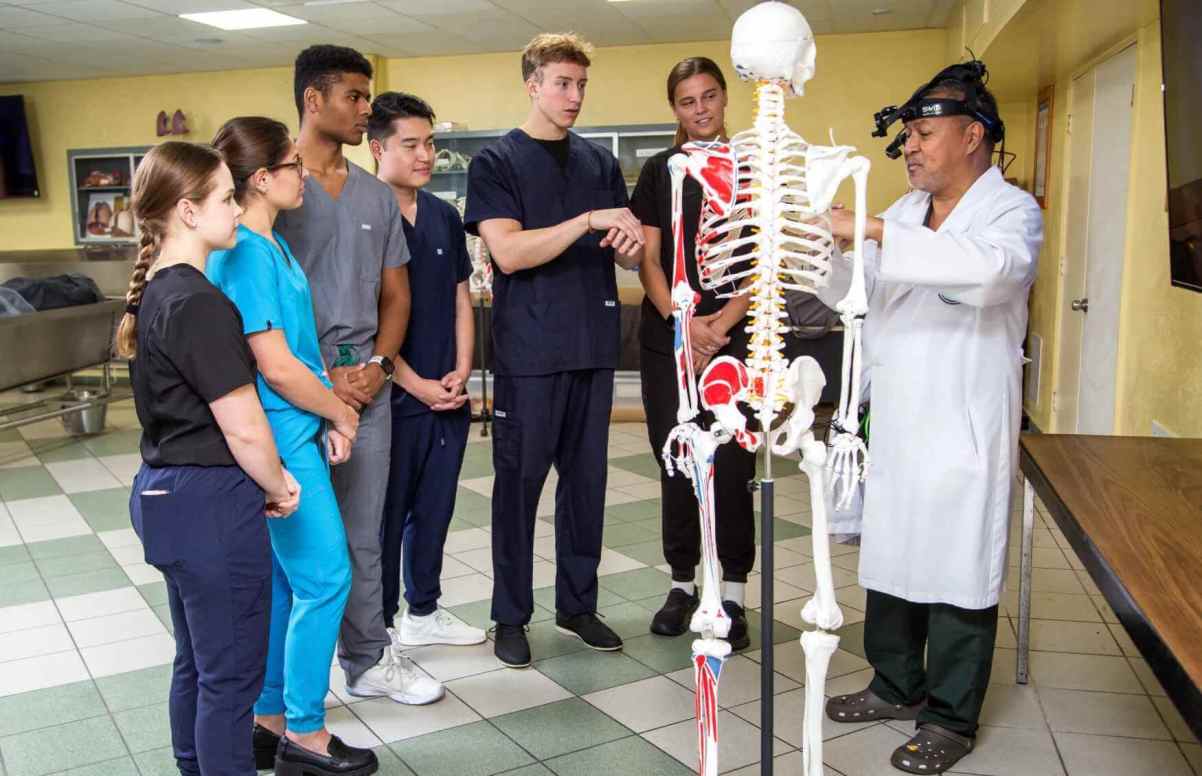
Why Accreditation Matters When Choosing a Caribbean Medical School
Explore the benefits of joining an accredited MD program.
For thousands of aspiring physicians each year, completing a 4-year MD program at an accredited Caribbean medical school will determine whether their degrees will be recognised for licensure, residency, and employment in the United States and Canada.
This guide breaks down everything you need to know about Caribbean medical school accreditations and recognitions, how accreditation impacts your licensing, residency prospects and potential career outcomes, and clarifies how to verify a school’s status before you apply.
What Is Medical School Accreditation?
Accreditation is a formal recognition that verifies whether a medical school meets defined standards of educational quality, institutional integrity and graduate competency. It’s not a one-time award but an ongoing process that requires schools to continuously demonstrate compliance with evolving standards through reviews, site visits and outcome data. For students, accreditation provides assurance that the institution delivers quality medical education that meets internationally recognized standards.
Why Accreditation Matters for Medical Students?
Many MD program applicants will understandably focus on tuition costs, location or admissions possibilities, but it’s also important to truly understand why accreditation matters. Without it, your career options can be restricted, regardless of how well you perform academically. Medical school accreditation can impact the following aspects of your medical training journey.
- Eligibility for the USMLE: Accreditation status can determine whether students are eligible to sit for the USMLE step exams. Without passing Steps 1, 2 CK and 3, international medical graduates cannot obtain a license to practice medicine in the United States.
- U.S. state medical board recognition: Some states – including California, New York and Florida – maintain strict lists of recognized schools that are appropriately accredited.
- Pathway opportunities: Accredited medical schools will often have established clinical training partnerships and can provide access to certain government financial aid programs.
Types of Accreditations and Recognition that Matter the Most
When evaluating Caribbean medical school accreditations and recognitions, look out for several designations that carry real weight with U.S. licensing and residency authorities:
- WFME Recognition: The World Federation for Medical Education (WFME) is a global organization that sets international standards for medical education and maintains a list of accrediting bodies it recognizes as meeting those standards.
- State Medical Board Recognition: Certain individual state boards maintain their own lists. If you plan to practice in a specific U.S. state, check its requirements early, as recognition varies.
- ECFMG Certification: The Educational Commission for Foreign Medical Graduates (ECFMG) certification is required for internationally trained physicians to enter U.S. residency and fellowship programs. To be ECFMG-certified, a graduate must have attended a school listed in the WDOMS.
Saba University School of Medicine (SUSOM) Accreditation Status
SUSOM is accredited by the Accreditation Organization of the Netherlands and Flanders (NVAO), which is recognized by the World Federation of Medical Education (WFME). The standards set by NVAO have been determined to be comparable to those utilized in accrediting medical schools in the United States by the U.S. Department of Education’s National Committee on Foreign Medical Education and Accreditation (NCFMEA). SUSOM is the only medical school in the Caribbean to meet the rigorous standards of European accreditation.
Saba University School of Medicine is also one of the few international medical schools with approvals in the key U.S. states of New York, California and Florida. These states mandate regular institutional reviews and approvals prior to granting access to clerkship opportunities or residency programs in their respective states, and other states rely on these approvals for the purposes of licensure.
Want to Learn More?
Contact our admissions team to learn more about our accreditation and recognitions.
Accreditation and Residency Match Opportunities
Aspiring medical students often enter a Caribbean medical school with the hope of entering a U.S. or Canadian residency program after graduation. While attending an accredited Caribbean medical school doesn’t guarantee a North American residency placement, it is almost always a prerequisite for consideration.
In 2025, international medical graduates (IMGs) achieved a 58% match rate, with more than 60% securing residency positions overall. Accredited schools tend to report higher residency placement outcomes due to stronger curriculum standards, USMLE preparation and established clinical rotation networks.
At SUSOM, we are proud to share that our students have achieved a 97% Three-Year Residency Placement Rate (2022-2025)!*
How Accreditation Impacts USMLE Eligibility
Since 2024, ECFMG has enforced the requirement that graduates must come from a school accredited by a WFME-recognized organization. This policy was introduced to raise the quality bar for international medical graduates entering the U.S. healthcare system and to align ECFMG standards with the global framework established by the WFME. Without ECFMG certification, there is no U.S. residency. Without a U.S. residency, there is no U.S. medical license.
How to Verify a Caribbean Medical School’s Accreditation Status
If you want to know how to choose a Caribbean medical school that is accredited, you should:
- Check WDOMS (wdoms.org) to ensure the school is listed.
- Review the WFME website for accrediting bodies they recognize.
- Visit state medical board sites if you plan to practice in North America.
- Ask the school directly for documentation of its accreditation status, the name of its accrediting body, confirmation of that body’s WFME recognition, and data on its USMLE pass rates and residency match rates.
Accredited vs. Non-Accredited Caribbean Medical Schools
Understanding the difference between accredited vs. non-accredited medical schools in the Caribbean is critical when deciding on the MD programs you plan to apply for.
Accredited Schools
Accredited medical schools undergo rigorous evaluation by a recognized external body and have met defined standards for curriculum quality, faculty qualifications, clinical training, student support and institutional governance. Graduates are eligible for:
- ECFMG certification
- USMLE Steps 1, 2 CK and 3
- Licensure consideration by U.S. state medical boards
- Clinical rotations at established teaching hospitals
Non-Accredited Schools
Non-accredited medical schools have not been evaluated and approved by a recognised accrediting body. Graduates may face:
- Ineligibility for USMLE registration
- Inability to obtain ECFMG certification
- Difficulty securing clinical rotations
- Rejection by many employers or licensing boards
- Potential need to repeat some or all of their medical education
What Happens if a School is Not Accredited?
Graduates of non-accredited schools are generally not eligible for ECFMG certification. Without ECFMG certification, they cannot enter U.S. residency programs through the NRMP or other residency placement systems. A non-accredited degree may leave a graduate with extremely limited options for practicing medicine anywhere outside the school’s home country. Many employers may not recognize the degree, even outside the U.S., and career options may be limited.
Common Myths About Caribbean Medical School Accreditation
Myth 1: Caribbean medical schools are not accredited
A misconception is that Caribbean schools operate with no recognition. In reality, many Caribbean schools are fully accredited – such as Saba University School of Medicine, which has decades of student success, rigorous curricula and strong residency match rates. Viewing all Caribbean medical schools the same can lead to missed opportunities.
Myth 2: Accreditation doesn’t matter if you plan to practice outside the U.S.
Most developed countries – including Canada, the U.K. and Australia – align their standards with WFME expectations. Accreditation still very much matters.
Myth 3: High USMLE scores will compensate for a non-accredited school
Students from non-accredited schools are generally ineligible to sit for the USMLE at all, because they cannot obtain ECFMG certification without graduating from a school with WFME-recognized accreditation. Furthermore, physicians the world over recognize that medical education encompasses much more than taking a test. Accreditation helps ensure that graduates are fully prepared to enter post-graduate residency training.
Tips for Choosing the Right Caribbean Medical School
Here are some practical tips for choosing an accredited Caribbean medical school that will serve your career goals:
- Confirm accreditation through WDOMS, ECFMG and WFME.
- Review residency placement data and ask for specialty breakdowns.
- Verify USMLE pass rates, especially first-attempt scores.
- Check clinical rotation partnerships with recognized hospitals in the U.S. or Canadian hospitals.
- Visit campus and speak with alumni to understand support systems and academic culture.
Saba University School of Medicine – An Accredited Caribbean Medical School
Saba University School of Medicine is an established and accredited Caribbean medical school that holds accreditation by the NVAO, recognition from the WFME and is fully eligible for ECFMG. SUSOM graduates regularly match into competitive residency programs across North America, and benefit from attending clinical rotations in the U.S. (core and electives) and Canada (select electives).
For more on the advantages of studying at an accredited Caribbean school, read our Top Reasons to Study at an Accredited Caribbean Medical School.
For U.S. students interested in what an accredited Caribbean medical education offers, SUSOM has developed resources specifically for your journey: Study Medicine in the Caribbean for U.S. Students.
For more information about the SUSOM experience from a practicing alum in the United States, view this testimonial video:
Then start your own journey by contacting us with any questions, checking out our admissions events page and learning how to apply.
FAQs About Accreditation
If your school is not accredited by a WFME-recognized body, you will be ineligible for ECFMG certification, which blocks you from entering U.S. residency programs and obtaining a U.S. medical license.
- A regional or national accreditation (e.g., NVAO)
- WFME recognition
- U.S. state medical board recognition
Yes, U.S. hospitals regularly hire physicians who were trained at accredited Caribbean medical schools for a diverse range of medical specialty roles.
Yes, but only if the school’s accrediting body holds WFME recognition and the graduate completes USMLE exams, ECFMG certification, a U.S. residency and state licensure requirements.
*97% Three-Year Residency Placement Rate is the percent of students attaining a residency position out of all graduates or expected graduates in 2022-2023, 2023-2024 and 2024-2025 who were active applicants in the NRMP match or attained a residency outside the NRMP match.
For Prospective Students
SUSOM is committed to supporting prospective students throughout the admissions process. Please click the following links for detailed information about each topic: